In India, the overall health status of a woman is realised through hair growths. Women with thick, lustrous, long hair are considered to have good health. Hair loss is a common issue in women too. It is a myth that only men experience baldness, while statistics show more than 50% of women deal with hair loss.
While women undergo excessive hair thinning issues attributed to stress, pollution, hormones, and genes, female hair transplant in India have become more popular and demanding. Women, like men, can have a hair transplant to counter pattern baldness and have long-lasting thick, shiny hair.
This article explores everything you need to know about hair loss in women and hair transplant procedures designed for women.
Table of Contents
Feel free to skip ahead if one topic catches your eye:
- What Is Hair Loss In Women?
- What Causes Hair Loss in Women?
- Procedure and Techniques of Female Hair Transplant in India
- Advantages of a Female Hair Transplant in India
- Frequently Asked Questions
- Conclusion
1. What is Hair Loss in Women?
Hair loss in women is when you unexpectedly lose more than 150 strands a day or find bald spots or a part of the hair widening due to heavy hair shedding. There are different types of patterns of hair loss in women.
Generally, women lose 50 to 100 strands a day. And this is common, as shedding is a part of the hair growth cycle, and hair regrows simultaneously, creating a natural balance. But, when the hair loss takes a toll of heavy shedding and hair regrowth slows down, the alarm bells ring for early treatment or immediate action.
Some of the types of hair loss seen in women are:
Anagen Effluvium: This is a form of nonscarring hair loss commonly occurring due to medications like chemotherapeutic drugs.
Telogen Effluvium: This is another hair loss from where the number of follicles in the telogen or shedding phase of the hair growth cycle is high. Stress, pollution, and genes externally affect hair growth, pushing the hair cycle to an extended resting phase and shedding.
Androgenetic Alopecia: This is the most common type of patterned hair loss or balding in women where the hair thins from the top and sides of the head.
2. What Causes Hair Loss in Women?
Some of the potential causes of hair loss in women are:
- Traction alopecia: Pulling the hair tightly from the roots while damaging the follicles and causing permanent hair loss.
- Alopecia areata is an autoimmune skin disease that leads to temporary hair loss on the scalp and other body parts.
- Vitamin deficiency,
- Excess loss of weight and restricted dieting,
- Side effects of supplements, and medications, including those used in cancer treatment.
- Physical stress, trauma causing temporary hair loss,
- Emotional or psychological stress,
- Thyroid issues,
- Predisposed genes,
- Medical conditions like anaemia or pregnancy,
- Ageing and menopause.
3. Procedure and Techniques of Female Hair Transplant in India
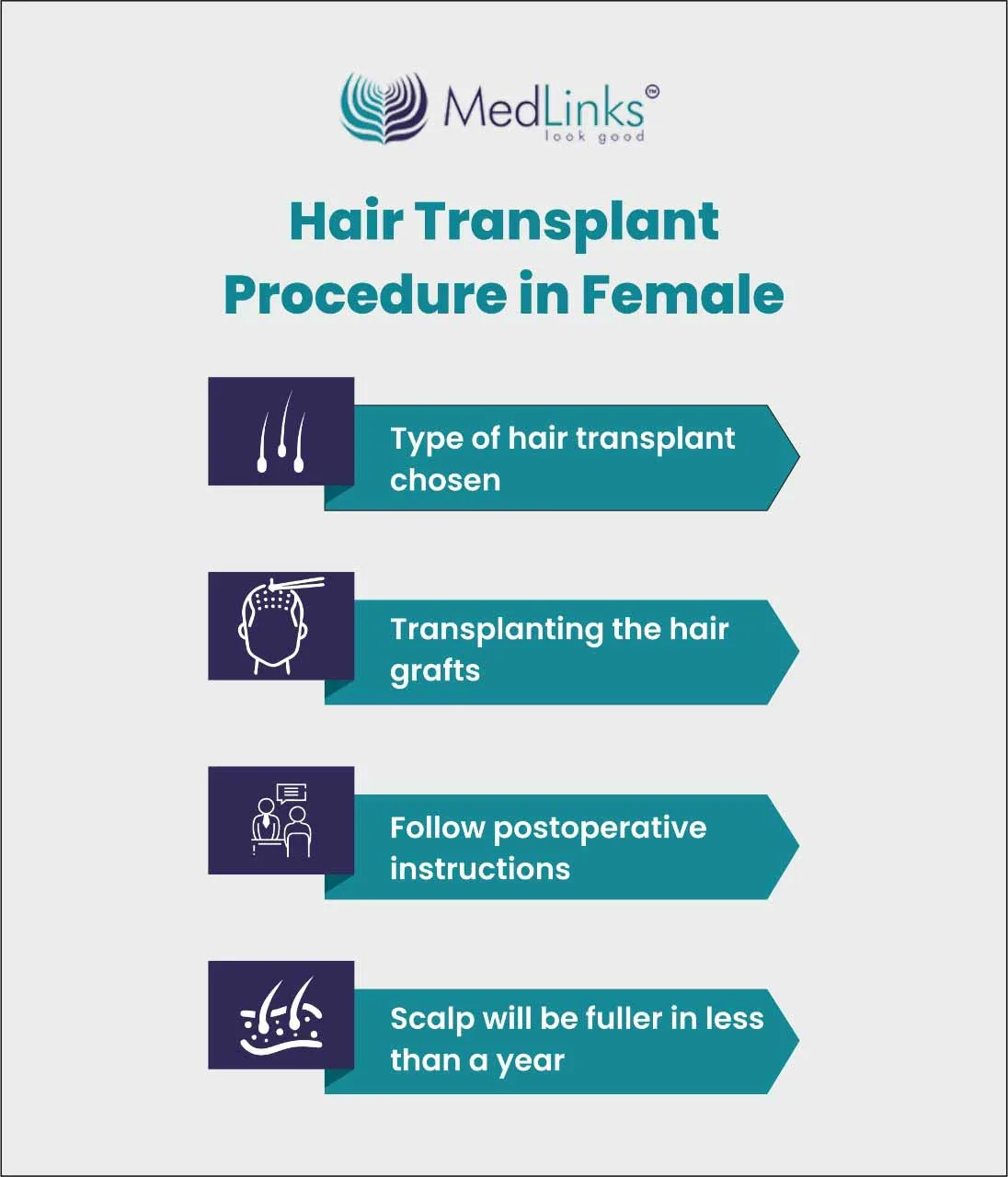
The techniques used to counter excessive hair loss in females include Follicular Unit Transplant (FUT) and Follicular Unit Extraction (FUE). Here is a flow of events of FUT and FUE procedures.
The procedure of a FUT hair transplant
FUT procedure requires the administration of local anaesthesia. After which, the surgeon conducts the following steps.
- Strips of skin with hair are harvested from the back regions of the head.
- The extracted hair strips are processed and cut to be implanted in the required location.
- Generally, a linear scar may be visible after FUT surgery.
- However, the scar can be covered with the surrounding hair falling over it.
FUT hair transplant requires no shaving or trimming of the hair. However, the recovery time post-FUT is nearly five weeks, but one can resume work a couple of days post-FUT hair transplant.
The procedure of an FUE hair transplant
FUE is a more refined hair grafting procedure that requires shaving or trimming the entire scalp. This procedure involves local anaesthesia administration, following which the surgeon conducts the below steps during an FUE hair transplant.
- Micro Punching technique helps extract individual hair follicles less than 1mm from the donor site.
- The recipient site is prepared by creating small incisions for graft implantation.
- The extracted hair follicles are implanted one by one in the incisions of the recipient site.
FUE offers faster recovery that is less painful and minimally invasive with fewer scarring. A Medlinks, Perfect-i FUE technique is an ultra-modern, scientific, and systematic procedure that assures less hair follicular damage, scalp tissue damage, and precise hair implantation.
Also Read: Female Hair Transplant In Mumbai
4. Advantages of a Female Hair Transplant in India
In women, hair transplant scars that are generally an issue can be covered with long hair regrowths. Secondly, women have potential donor sites, especially the scalp hair, that make them ideal candidates for a hair transplant. For women experiencing heavy hair loss and thinning issues, some benefits of hair transplant procedures in women include:
- It can provide a long-lasting permanent solution for hair loss concerns.
- The hair transplant treatment ensures natural, thick hair outcomes.
- Hair transplant allows for regular hair maintenance or the use of other hair treatments that can help improve hair strength and volume.
- It helps restore the beauty and aesthetic appearance of a woman with dense hair growths.
- It helps restore confidence and self-esteem.
Also Read: Female Hair Transplant Cost In Mumbai
5. Frequently Asked Questions
1. Is hair transplant successful in females?
Female hair transplant techniques can successfully address hair loss concerns. They are designed to provide permanent solutions for extreme female alopecia conditions by giving a hair-fuller appearance and boosting self-confidence.
2. Are hair transplants safe for women?
Yes. Hair transplant treatments are minimally invasive and safe procedures that ensure good, voluminous, natural hair growths.
3. Which is the best method for female hair transplant in India?
FUE involves fewer stitches, quick healing, and less pain. With promising better outcomes, FUE is the most popular hair transplant procedure. However, FUE hair transplant costs are usually higher than the FUT technique.
6. Conclusion
Though the pattern of baldness in women is different compared to men, the psychological distress of hair loss in women is much higher than in men. The causes of hair loss in women can be many, but hair transplant procedures can help them with long, dense, natural hair that grows organically.
For a standardised and precise hair transplant, you must visit us at Medlinks, your hair transplant destination in Delhi. We house state-of-the-art technology and highly experienced hair transplant surgeons who assure you the best treatment and quality outcomes.
Related Blogs
Medical disclaimer: this article is for general information and does not replace advice from a qualified doctor. Results vary between patients.