
- Home
- About Us
- Hair Transplant
- Hair Loss
- Medical Treatment
- Patients Gallery
- Our Patients
- Blog
- Contact Us
- Hair Transplant Cost
- Book an Appointment
- Brochure

If you're considering a hair transplant, you've likely come across terms such as hair grafts, follicular units, and graft count. One of the most common questions patients ask during a consultation is:
"What is a hair graft, and how many hairs does one graft contain?"
Understanding this concept is essential because hair transplant procedures are planned based on the number of grafts required—not individual hairs. A clear understanding of hair grafts can help you set realistic expectations regarding coverage, density, and overall results.
In this comprehensive guide, Dr. Gaurang Krishna from MedLinks Hair Transplants explains everything you need to know about hair grafts, how they are counted, and how many hairs you can expect from different graft counts.
A hair graft is a naturally occurring group of hair follicles that is extracted from the donor area and transplanted into areas affected by hair loss.
Contrary to popular belief, surgeons do not transplant individual hairs. Instead, they transplant follicular units, which are natural groupings of hair follicles found in the scalp.
A single graft may contain:
The distribution varies from person to person and is influenced by genetics, hair characteristics, and donor area quality.
Many patients mistakenly believe that a graft and a follicle are the same thing. However, there is an important distinction.
| Hair Graft | Hair Follicle |
|---|---|
| A group of follicles transplanted together | A single structure that produces a hair |
| May contain 1–4 hairs | Produces one or more hair strands |
| Used for transplant planning | Biological hair-producing unit |
For example, if a surgeon transplants 2,000 grafts, the actual number of hairs transplanted may be significantly higher because many grafts contain multiple hairs.
This is one of the primary reasons why clinics discuss graft counts rather than individual hair counts.
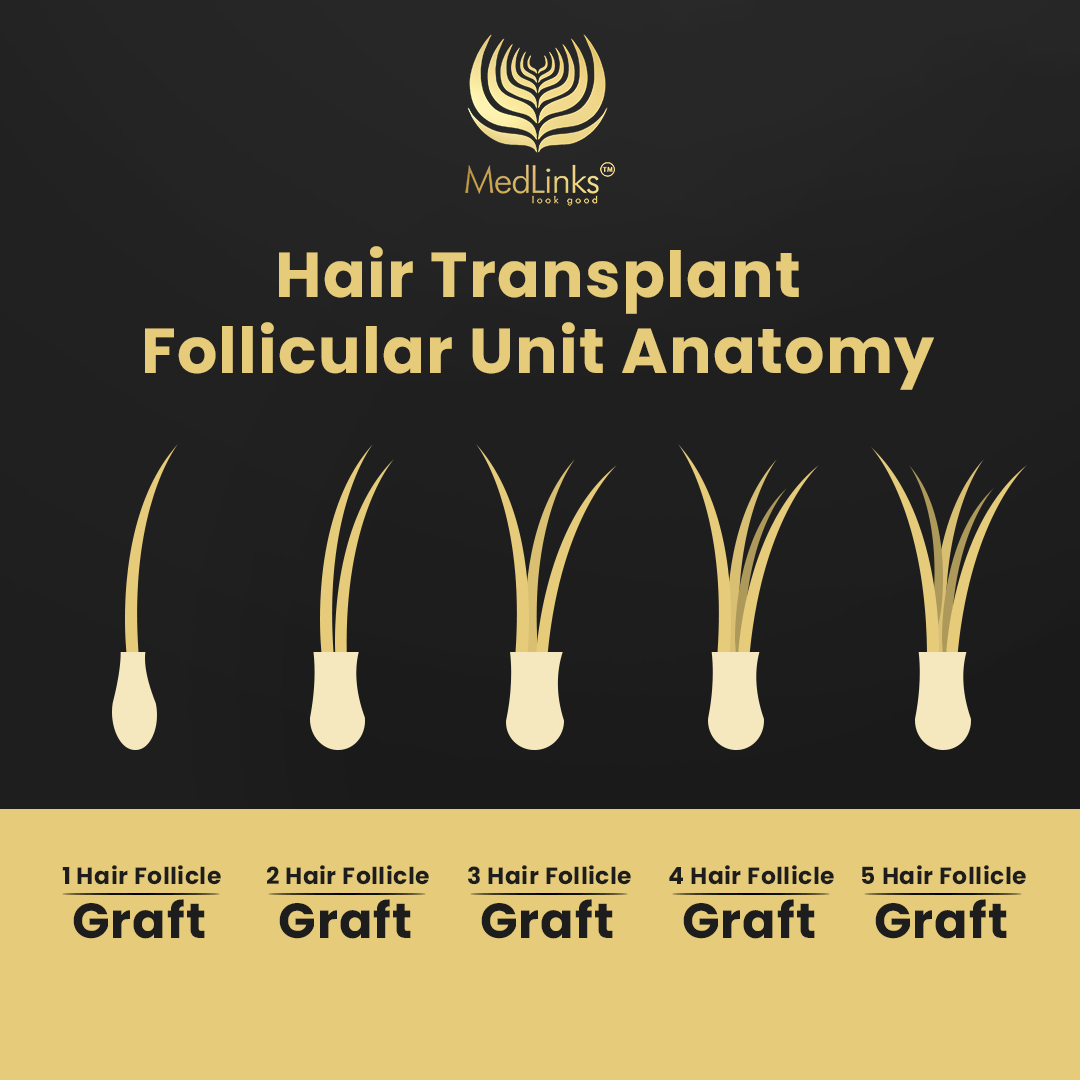
The number of hairs contained within a graft varies depending on an individual's follicular unit composition.
| Graft Type | Number of Hairs |
|---|---|
| Single-Hair Graft | 1 Hair |
| Double-Hair Graft | 2 Hairs |
| Triple-Hair Graft | 3 Hairs |
| Quadruple-Hair Graft | 4 Hairs |
In most patients, the average hair count per graft is between 2 and 2.5 hairs.
This means:
| Number of Grafts | Approximate Hair Count |
|---|---|
| 1000 Grafts | 2000–2500 Hairs |
| 2000 Grafts | 4000–5000 Hairs |
| 3000 Grafts | 6000–7500 Hairs |
| 4000 Grafts | 8000–10000 Hairs |
It's important to remember that these figures are estimates. Actual numbers depend on the quality and composition of the donor area.
Not every patient has the same follicular unit composition. Several factors influence the number of hairs contained within a graft.
Genetics play the most significant role in determining hair density and follicular unit structure. Some individuals naturally have a higher percentage of multi-hair grafts.
Patients with dense donor areas often possess a greater number of double, triple, and quadruple-hair grafts.
Thicker hair shafts provide better visual coverage and may create the appearance of greater density.
Hair characteristics differ among populations, influencing both graft composition and coverage potential.
Curly or wavy hair often provides more visual coverage than straight hair, even when graft counts are identical.
Accurate graft counting is a critical step in successful hair restoration planning.
The surgeon assesses:
Each graft is examined under magnification and categorized according to the number of hairs it contains.
The surgeon determines:
This systematic approach helps create natural-looking and long-lasting results.
Hair transplant procedures are standardized using graft counts because grafts represent the actual units transplanted during surgery.
Using graft counts allows surgeons to:
This method provides a more reliable framework for treatment planning than counting individual hairs.
Every patient is unique, but the following estimates are commonly used during consultation.
| Hair Loss Stage | Typical Graft Requirement |
|---|---|
| Mild Hairline Recession | 1000–1500 Grafts |
| Early Frontal Loss | 1500–2200 Grafts |
| Moderate Hair Loss | 2200–3000 Grafts |
| Advanced Hair Loss | 3000–4500 Grafts |
| Extensive Baldness | 4500+ Grafts |
The actual number depends on:
Many people assume that the same graft count produces identical results. This is not true.
Several factors influence the final appearance:
Thicker hair provides greater scalp coverage.
Lower contrast between hair and scalp creates the appearance of greater density.
Curly hair covers more scalp area than straight hair.
Skin tone and scalp visibility influence perceived density.
Because of these factors, experienced surgeons focus on cosmetic density rather than simply maximizing graft numbers.

Dr. Gaurang Krishna is a leading Hair Transplant Surgeon at MedLinks Hair Transplants and has extensive experience in diagnosing and treating various forms of hair loss.
He specializes in:
FUE Hair Transplant
High-Density Hair Restoration
Natural Hairline Design
Beard and Eyebrow Transplantati
Corrective Hair Transplant Procedures
Medical Hair Loss Treatments
At MedLinks Hair Transplants, Dr. Gaurang Krishna follows a personalized approach to hair restoration, ensuring every treatment plan is tailored to the patient's hair loss pattern, donor availability, and long-term goals.
✔ Personalized treatment planning
✔ Focus on natural-looking outcomes
✔ Advanced graft extraction techniques
✔ Long-term donor area preservation
✔ Comprehensive post-transplant support
Reality: Most grafts contain multiple hairs.
Reality: Proper placement and design are more important than simply increasing graft numbers.
Reality: Many patients achieve excellent outcomes with significantly fewer grafts.
Reality: Hairline design, graft survival, donor quality, and surgical expertise are equally important.
This article has been medically reviewed by Dr. Gaurang Krishna, Hair Transplant Surgeon at MedLinks Hair Transplants.
The information presented is based on current principles of follicular unit extraction (FUE), hair restoration surgery, and clinical experience treating patients with various stages of hair loss.
Our goal is to provide accurate, evidence-based information that helps patients make informed decisions regarding hair restoration procedures.
Understanding what a hair graft is and how many hairs it contains can help you make informed decisions about hair transplantation.
While a single graft does not equal a single hair, most grafts contain between 2 and 2.5 hairs on average. The exact number depends on your genetics, donor density, and follicular unit composition.
Whether you require 1,500 grafts for a receding hairline or 4,000+ grafts for advanced hair loss, the most important factor is receiving a personalized treatment plan from an experienced hair transplant surgeon.
If you're considering a hair transplant, schedule a consultation with Dr. Gaurang Krishna at MedLinks Hair Transplants to receive a detailed graft analysis and customized hair restoration strategy.
Ans. No. A graft may contain between 1 and 4 hairs. Most patients have an average of 2–2.5 hairs per graft.
Ans. Approximately 4000–5000 hairs, depending on follicular unit composition.
Ans. Most patients can expect approximately 6000–7500 hairs from 3000 grafts.
Ans. Around 8000–10000 hairs, depending on donor characteristics.
Ans. No. A follicle is a hair-producing structure, while a graft is a group of follicles transplanted together.
Ans. The answer depends on the extent of hair loss, donor supply, and desired density. Many advanced cases require between 3500 and 5000+ grafts.
Ans. Temporary shedding is normal after a hair transplant. In most cases, healthy transplanted follicles regrow hair within several months.
Ans. No. Natural design, proper graft placement, donor quality, and surgical expertise all play important roles in achieving successful outcomes.

Dr. Gaurang Krishna




Copyright © 2026 Medlinks. All Rights Reserved.
Disclaimer:The content published on this website(hairtransplantdelhi.org) is meant to spread awareness and educate the concerned patients regarding baldness and hair transplants as well as the treatment options available for baldness and hair transplant treatment in Delhi India. Any information on the website shall not be regarded as a prescription from a professional dermatologist. We recommend visiting a dermatologist in person for the right diagnosis and the treatment for any hair issues. We do not guarantee specific results as the treatments and the results vary from person to person.

